Introduction
It has been a week since much of the oil and gas industry from Colombia and the wider region gathered in Bucaramanga for the congress of ACIPET, the Colombian Association of Petroleum Engineers (El Ecosistema Startup, 2026). I have talked to several people who were there, and what they all share is enthusiasm for "what is coming", with unconventional reservoirs centre stage. The congress closed with the industry body calling for their development to be accelerated (Metropolitano, 2026).
That collective enthusiasm is, to me, a red flag. We have lived through this story before. We lived through it in Colombia's energy sector, and we have watched it repeat itself elsewhere with similar announcements and processes: in renewables, in artificial intelligence, in real estate, in commodities. The script changes its name and keeps its structure.
This piece is not addressed to the enthusiasts. On that front there is little to be done. It is addressed to capital allocators, who over the coming months will be bombarded by those same enthusiasts looking for funding for their delusions, their unicorns and their smoke.
I am convinced that unconventionals need to be developed, and I am a staunch defender of the country's energy self-sufficiency. On that I have no reservations: it is strategic for Colombia. My reading lies elsewhere. It lies with the players.
Three months
In Colombia, the political climate around unconventionals turned in a matter of weeks. In July, the outgoing government announced a bill to ban fracking (Colombia One, 2026). On 7 August, the new president announced in his inaugural address that he would authorise fracking, which on the campaign trail he had promised "a lo que dé" — as far as it will go (Yahoo Noticias, 2026a; La Silla Vacía, 2026). At the end of September, swearing in the new president of Ecopetrol, he declared exploration and the signing of new contracts reopened, unconventionals included (El Heraldo, 2026). The chairman of Ecopetrol's board has proposed leaving the pilot stage behind and moving straight to commercial production (Yahoo Noticias, 2026b). And the governor of Santander, facing a cut in royalties of close to a hundred billion pesos, called for the fracking debate to be opened: "we are going to run out of money next year" (Alerta Bucaramanga, 2026).
Yesterday's fracking demon is today's saviour. And around that conversion the usual crowd appears: the new experts, the new gurus, the politicians with their regions' hopes pinned on the boom. A spell in the field filling in Excel sheets and building slide decks turned many into specialists in unconventionals in the same span it took to change the government.
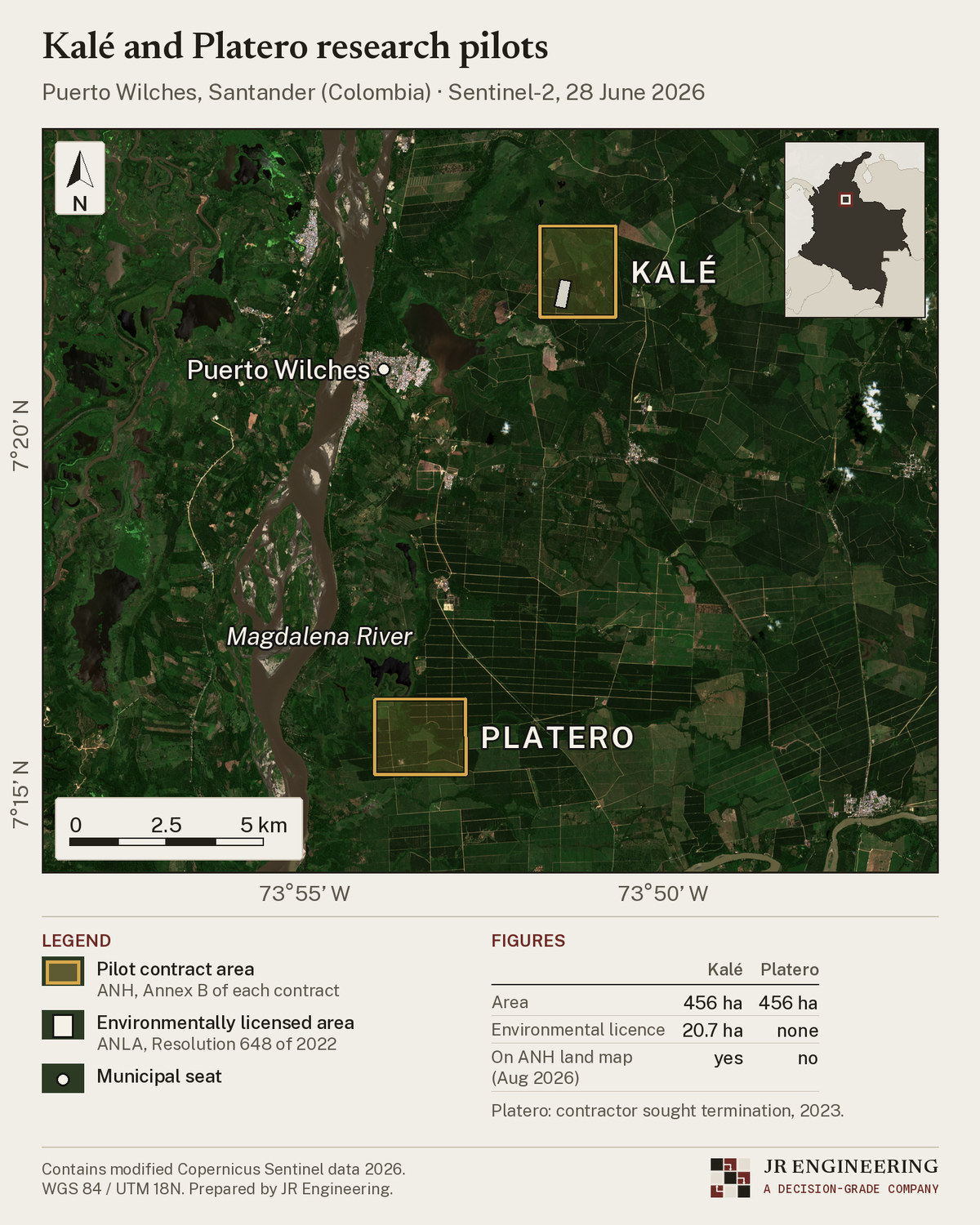
That is where anyone managing other people's money has to tread carefully. Because the subsurface does not obey politics. Nor do completions, reservoir characterisation, surface infrastructure or decline curves. The Kalé and Platero pilots, approved in 2021 with planned investment of close to US$130 million and conceived as research projects, were not an authorisation for commercial production (Infobae, 2026). If that process had to be restarted today, the technical timetable would still be far longer than the political one. Politics has already decided there is no time for that. The geology was not consulted.
Industrial memory
The global precedent is the most successful basin on the planet. According to Deloitte, the US shale boom peaked without making money for the industry as a whole: since 2010 it posted negative free cash flow of US$300 billion, impaired more than US$450 billion of invested capital and ran up more than 190 bankruptcies (Deloitte, 2020). The resource was real, the technology worked and the production came. Capital, in aggregate, was destroyed all the same.
The local precedent is Pacific Rubiales, which became the country's second-largest producer and was worth more than seven billion dollars on the stock market (El Tiempo, 2016; Portafolio, 2016). In 2016 it restructured US$5.4 billion of debt down to US$250 million; shareholders received one new share for every hundred thousand they held, and anyone holding fewer than a hundred thousand received nothing (Frontera Energy Corporation, 2016). More than seven thousand small shareholders registered in Colombia lost their investment (El Tiempo, 2016).
Unconventionals need not end the same way. But a real opportunity does not guarantee that the capital is well placed. In our latest Scouting Report on Colombian upstream, the six leading operators show operating netbacks of between US$38 and US$47 per barrel (JR Engineering Company, 2026). That margin is not the shareholder's return: it still has to absorb depreciation, corporate overhead, the servicing of capital and the other charges that the netback leaves out.
That usual crowd, that same sanhedrin of wildcatters and low-cost outfits, short on strategic judgement and operating at the edge of regulation, belongs to the ecosystem that left us the technological, industrial and strategic backwardness we have today in conventionals. And it is the one now presenting itself, with the same PowerPoint and a different title, as expert in shale.
The filter
The serious objection is that the market already filters: capital will go to whoever has drilled and fractured horizontal wells. I am not convinced. Drilling today is, to a large extent, a service you hire. The cheque gets you the rig. What sets an operator apart is that the well produces what the model promised. The operators in the Deloitte study knew how to drill; the returns never came.
Nor does the State set that filter. The regulations of the ANH, Colombia's National Hydrocarbons Agency, require the operator to demonstrate technical and operational capacity; the investor, by contrast, must show legal and economic-financial capacity (Agencia Nacional de Hidrocarburos, 2022). Regulation can verify who operates. It does not verify who, sitting around the investment table, actually knows how to develop an unconventional reservoir. That filter has to be set by whoever places the capital.
Know-how
Developing unconventionals demands technology and knowledge that a month in Vaca Muerta filling in spreadsheets does not confer. It is something else. It is another level. It is a deep understanding of how to do the work, not how to talk about it. Someone who has explained shale at a conference and someone who has drilled, completed and produced a multistage horizontal well for twenty-four months share the vocabulary and very little else. Someone who builds an elegant financial model and someone who recognises that the model rests on an operationally impossible premise are, as a rule, two different people. And that second capability, as ever, is in very few hands.
Those few will have the advantage. They will win the best-quality capital, and they will very likely do very well. The rest will fare less well, and the capital that goes into their ventures is likely to be impaired or to vanish.
So, before asking about EUR, IRR or the size of the resource, I would ask something a good deal less sophisticated. Who at this table has done this before, where, with what technology and with what actual decline at two years? How much of that capability lives inside the organisation, and how much depends on a contractor who is also selling to the other five? How much of their own money is in the project? What happens to the model when the price, the drilling time or the well's productivity behave like the subsurface and not like the spreadsheet? And what percentage of the capital I am being asked for goes to overhead before it touches a rig?
The capital will come. It will come accompanied by excellent presentations, large resources, sophisticated models and a long list of people who now know perfectly well how to develop an unconventional reservoir. Beneath all the enthusiasm lies a less glamorous question: who knows how to do this?
References
- Agencia Nacional de Hidrocarburos. (2022, 25 July). Acuerdo 003 de 2022, por el cual se adopta el Reglamento de Selección de Contratistas y Asignación de Áreas para Exploración y Explotación de Hidrocarburos (art. 13, technical and operational capacity; art. 25, repeal of Acuerdo 02 de 2017). https://www.anh.gov.co/documents/14867/ACUERDO_003_DE_2022.pdf
- Alerta Bucaramanga. (2026, 27 September). Santander pide debate fracking tras recorte de regalías. https://bucaramanga.alerta.com.co/quejodromo/santander-pide-debate-fracking-tras-recorte-de-regalias-251668
- Colombia One. (2026, 12 July). The Colombian Government Will Introduce an Anti-Fracking Bill on July 20. https://colombiaone.com/2026/07/12/the-colombian-government-will-introduce-an-anti-fracking-bill-on-july-20/
- Deloitte. (2020, June). The Great Compression: Implications of COVID-19 for the US Shale Industry. Figures as cited in Rassenfoss, S. (2020, 20 July). Are Half the Companies in Shale Really Superfluous? Journal of Petroleum Technology. https://jpt.spe.org/are-half-companies-shale-really-superfluous
- El Ecosistema Startup. (2026, 19 September). Congreso de ACIPET en Bucaramanga: la apuesta por IA y sensores en petróleo. https://ecosistemastartup.com/congreso-de-acipet-en-bucaramanga-la-apuesta-por-ia-y-sensores-en-petroleo/
- El Heraldo. (2026, 26 September). "Fracking a lo que dé": De la Espriella anuncia que reactivará la exploración de hidrocarburos. https://www.elheraldo.co/economia/2026/09/26/fracking-a-lo-que-de-de-la-espriella-anuncia-que-reabrira-la-exploracion-de-hidrocarburos/
- El Tiempo. (2016, 3 November). Socios pequeños de Pacific pierden inversión. https://www.eltiempo.com/economia/empresas/socios-pequenos-de-pacific-pierden-inversion-51451
- Frontera Energy Corporation. (2016, 2 November). Pacific completa la transacción de reestructuración. https://fronteraenergy.mediaroom.com/news?item=123350
- Infobae. (2026, 28 September). Reactivación del fracking en Colombia: Ecopetrol, Drummond y GeoPark lideran el regreso de la exploración. https://www.infobae.com/colombia/2026/09/28/reactivacion-del-fracking-en-colombia-ecopetrol-drummond-y-geopark-lideran-el-regreso-de-la-exploracion/
- JR Engineering Company. (2026). Scouting Report — Colombia Upstream 1Q26. https://intelligence.jrengineering.com.co/scouting/SR_COL_Upstream_1Q26.html
- La Silla Vacía. (2026, 23 June). Preguntas y respuestas alrededor del fracking en Colombia. https://www.lasillavacia.com/silla-amazonia/amazonia-en-breve/preguntas-y-respuestas-alrededor-del-fracking-en-colombia/
- Metropolitano. (2026, 25 September). Congreso de Petróleo y Gas concluye en Bucaramanga con llamado a acelerar proyectos de Yacimientos No Convencionales. https://metropolitano.com.co/congreso-de-petroleo-y-gas-concluye-en-bucaramanga-con-llamado-a-acelerar-proyectos-de-yacimientos-no-convencionales/
- Portafolio. (2016, 29 April). Pacific explica reestructuración [interview with Miguel de la Campa and Serafino Iacono]. https://www.portafolio.co/negocios/empresas/pacific-explica-reestructuracion-494967
- Yahoo Noticias. (2026a, 8 August). El primer discurso de De la Espriella: de la "batalla cultural" al "fracking sostenible". https://es-us.noticias.yahoo.com/discurso-espriella-batalla-cultural-fracking-021056467.html
- Yahoo Noticias. (2026b, 9 August). Nuevo presidente de Junta de Ecopetrol sugiere hacer fracking «ya, no estamos para pilotos». https://es-us.noticias.yahoo.com/presidente-junta-ecopetrol-sugiere-fracking-190000836.html