Introduction
The deficit is real, and nobody disputes that. In 2025 metered gas production fell 12%, taking the cumulative decline since 2021 to 31%; proven reserves went from 3,164 to 1,717 billion cubic feet over the same period (Promigas, 2026). Import dependence is already entrenched: volumes regasified at SPEC LNG, the Promigas terminal in Cartagena, rose from an average of 5 million cubic feet per day in 2021 to 174 in 2025, and imported gas has accounted for 28% of total supply so far in 2026, with a peak of 34% in August (Promigas, 2026).
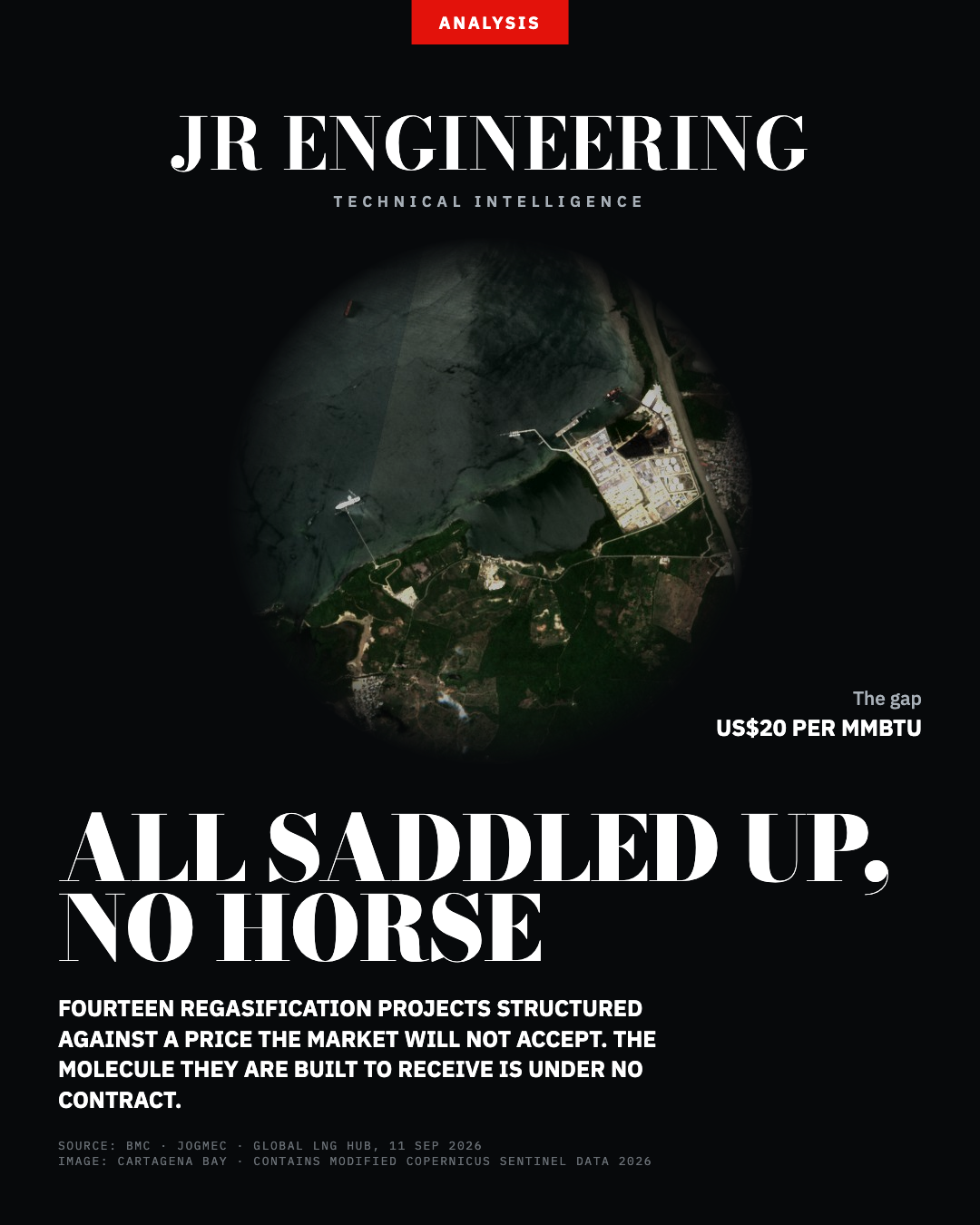
The response has been to build. There are fourteen regasification projects at various stages (La República, 2026), and the Bolsa Mercantil de Colombia forecasts contracting that runs into the 2030s (BMC, 2026).
The question the race leaves unanswered is arithmetic. A regasification terminal does not produce gas: it receives it. Its viability rests on a molecule being available at a price that somebody in Colombia can pay.
The price Colombia can bear
The negotiated price in Colombia's primary gas market is US$10.93 per million British thermal units (MMBtu) in 2026. In 2019 it was US$6.36 (BMC, 2026). That is a rise of 72% in seven years, before transport and distribution, and before most of the import capacity has come on stream.
Alberto Consuegra, president of Amazónica LNG, has said publicly that its regasified gas would sell at between US$11 and US$13 per MMBtu (Portafolio, 2026). Imported gas reaches the market at or above what the primary market already pays, a price that is itself up 72%. Transport, distribution and marketing are added afterwards.
Firm contracts exist. The question is who gets them
Long-term firm contracts exist, get signed and are by and large honoured. Access to them is not universal.
A producer with a cargo to place does not weigh its cost against the Colombian price; it weighs the Colombian price against its best alternative. And when supply runs short, it ranks its customers by strategic value. When QatarEnergy ran short in 2026, it bought 33 US spot cargoes — against four the year before — and redirected them to Japan, South Korea, India, Bangladesh and Taiwan. The force majeure notices had reached long-term contracts in Asia and in Europe (Al Jazeera, 2026); not one replacement cargo went to Italy or Belgium (EnergyNow, 2026; OilPrice, 2026; The New Arab, 2026).
All of these buyers held firm contracts with Qatar. What determined who received a replacement molecule and who received only a letter was not production capacity: it was each customer's place in the hierarchy. And the instrument Qatar used to protect its own was buying spot.
As far as the public record shows, Colombia does not currently sit in the strategic tier of the large producers' customers. For its buyers, the alternative on offer may turn out to be the spot market, or a formula the seller will accept at a premium.
Why better negotiation will not bring that price down
Since QatarEnergy declared force majeure on Ras Laffan on 4 March 2026 and the Strait of Hormuz was effectively closed, benchmark prices in the importing markets have not returned to their previous level (QatarEnergy, 2026). August's two spikes have become three, and September's is the highest in roughly two and a half years (JR Engineering Company, 2026a; JOGMEC, 2026).
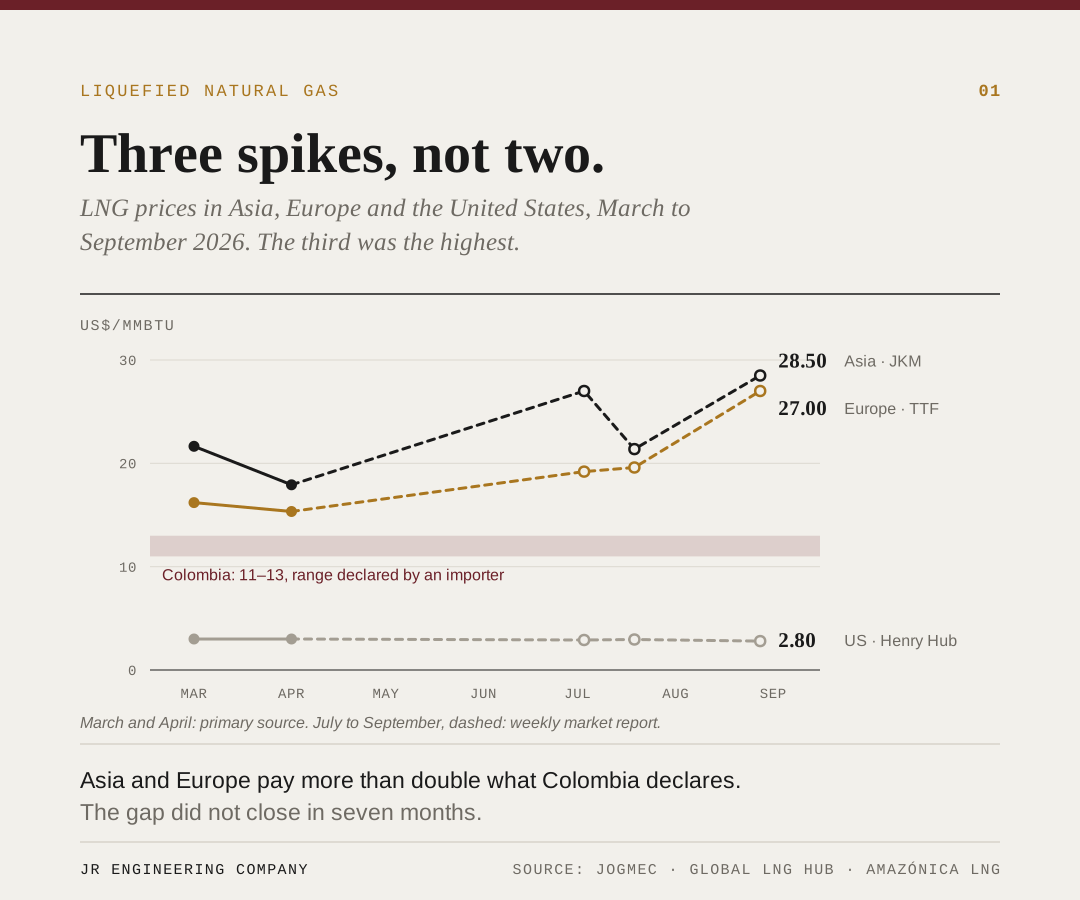
Henry Hub, the US benchmark, stayed flat throughout, between US$2.8 and US$3.0, insulated by domestic production. The import benchmarks did not: JKM, the north-east Asian LNG marker, and TTF, the Dutch hub that prices European gas, both broke away. On 11 September JKM stood about US$25.7 per MMBtu above Henry Hub, and TTF about US$24.2. Liquefaction and shipping cost about US$3 to US$4 to the Atlantic Basin and US$5 to US$6 to Asia (GaffneyCline, 2025). What remains of the differential is, in essence, the rent available to whoever controls the molecule.
A standard 160,000-cubic-metre LNG carrier delivers about 3.6 million MMBtu. On a differential of eleven dollars per MMBtu — conservative against September's levels — the seller's sum comes to about forty million dollars a cargo. On the twenty-dollar gap between the two price build-ups described below, seventy-two; at the JKM–Henry Hub differential observed on 11 September, ninety-two.
Forty million a cargo is what a seller leaves on the table each time it ships cheaply to a buyer who is not high on its list. Repeat that for seven years.
Two ways of building the same price
Here is the problem: two prices for the same molecule. Colombia adds up costs. Whoever holds the molecule compares destinations.
A regasification project is structured by adding up costs: gas at origin, liquefaction, freight, regasification, inland transport. The sum yields a tariff, which is then set against what the market pays. It lands at around US$9.3 per MMBtu delivered at the city gate — the point of delivery into the distribution network — consistent with the US$10.93 the primary market already pays.
Whoever holds the molecule does not price it the way Colombia structures the project: they price it on opportunity cost. They start from what the best alternative market would pay, take off the freight to get there, and add the freight to Colombia and the regasification: 27.00 − 0.90 + 0.40 + 2.90. That build-up lands close to US$29.4.
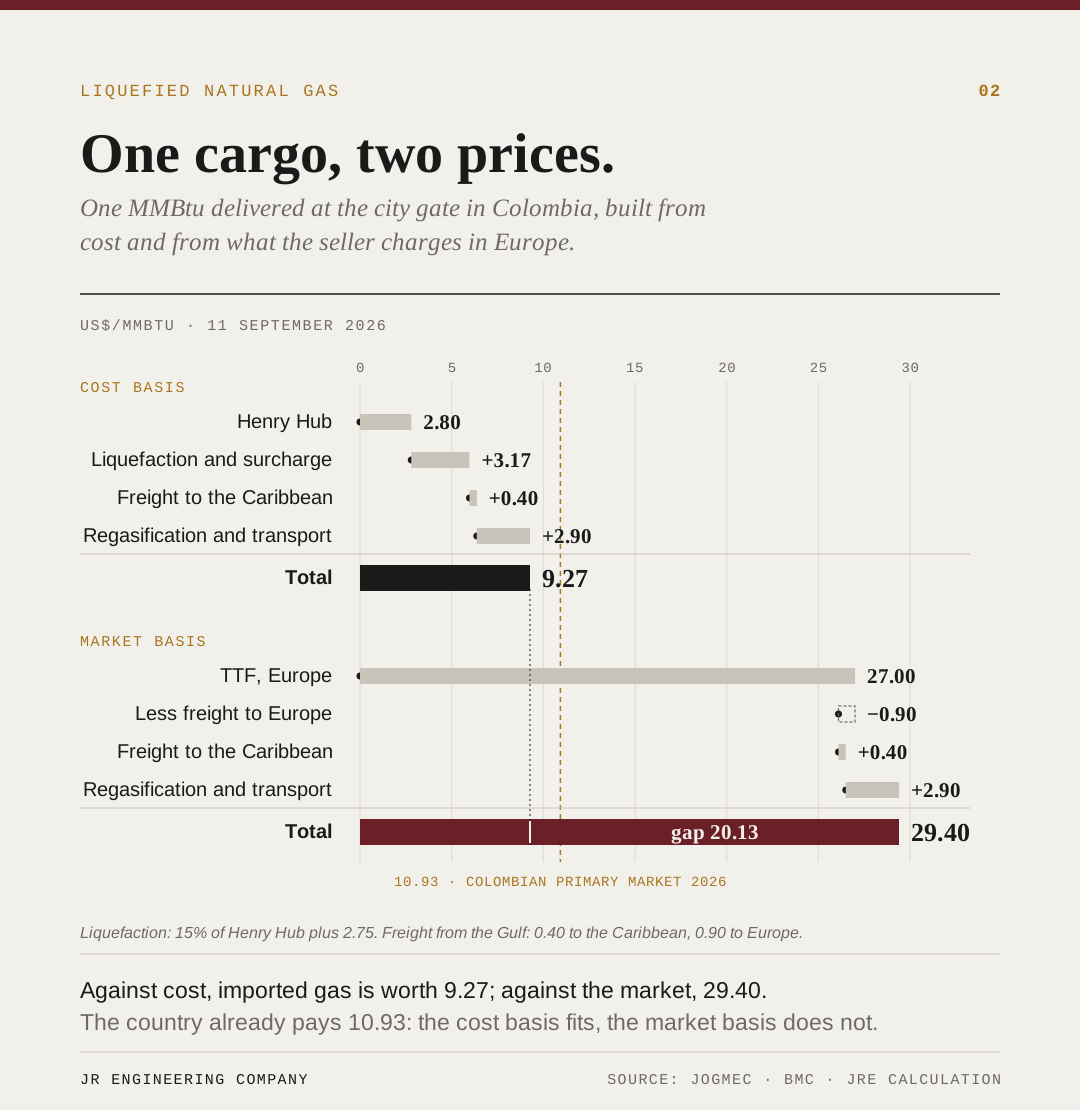
A gap of twenty dollars per MMBtu. It is not an overrun that efficiency will correct, because whoever holds the molecule uses the second sum.
The arbitration record shows that contracts sometimes leave the seller room to sell to the higher bidder, though not always. Shell and Repsol lost to Venture Global over cargoes withheld during the commissioning of Calcasieu Pass — the International Chamber of Commerce tribunals held that those cargoes were not subject to the long-term obligations — and a New York court declined in March 2026 to set aside the award against Shell. BP, by contrast, won its arbitration on the same facts (Enyo Law, 2026; Insurance Journal, 2026). At its volumes, and without long-term contracts, Colombia is a price-taker: it takes what is left.
Venezuela and Trinidad: the same sum
Promigas lists Venezuelan gas among the import alternatives, with the caveat that it should complement supply without creating a new dependence (Promigas, 2026). The same arithmetic applies.
There is no Venezuelan gas available today for firm export: the Dragon field, of some 4.2 trillion cubic feet, has yet to produce; the United States revoked its licence in 2025 and later re-authorised it in stages, the first for negotiation only (Enerdata, 2025). Trinidad has the mirror-image problem: Atlantic LNG has nameplate capacity of close to 12 million tonnes a year and exported around 9 in 2025, on production below 3 billion cubic feet per day (Natural Gas Intelligence, 2026).
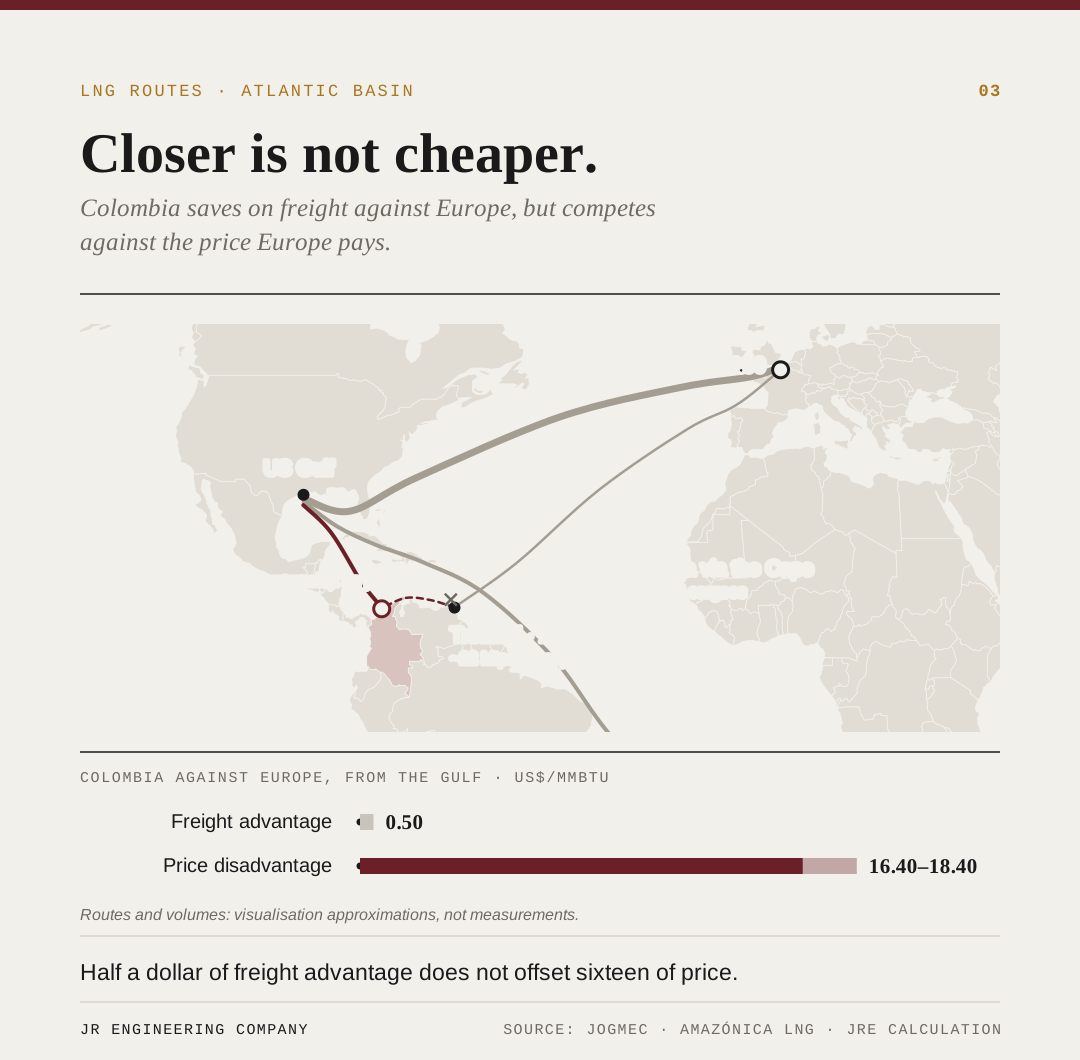
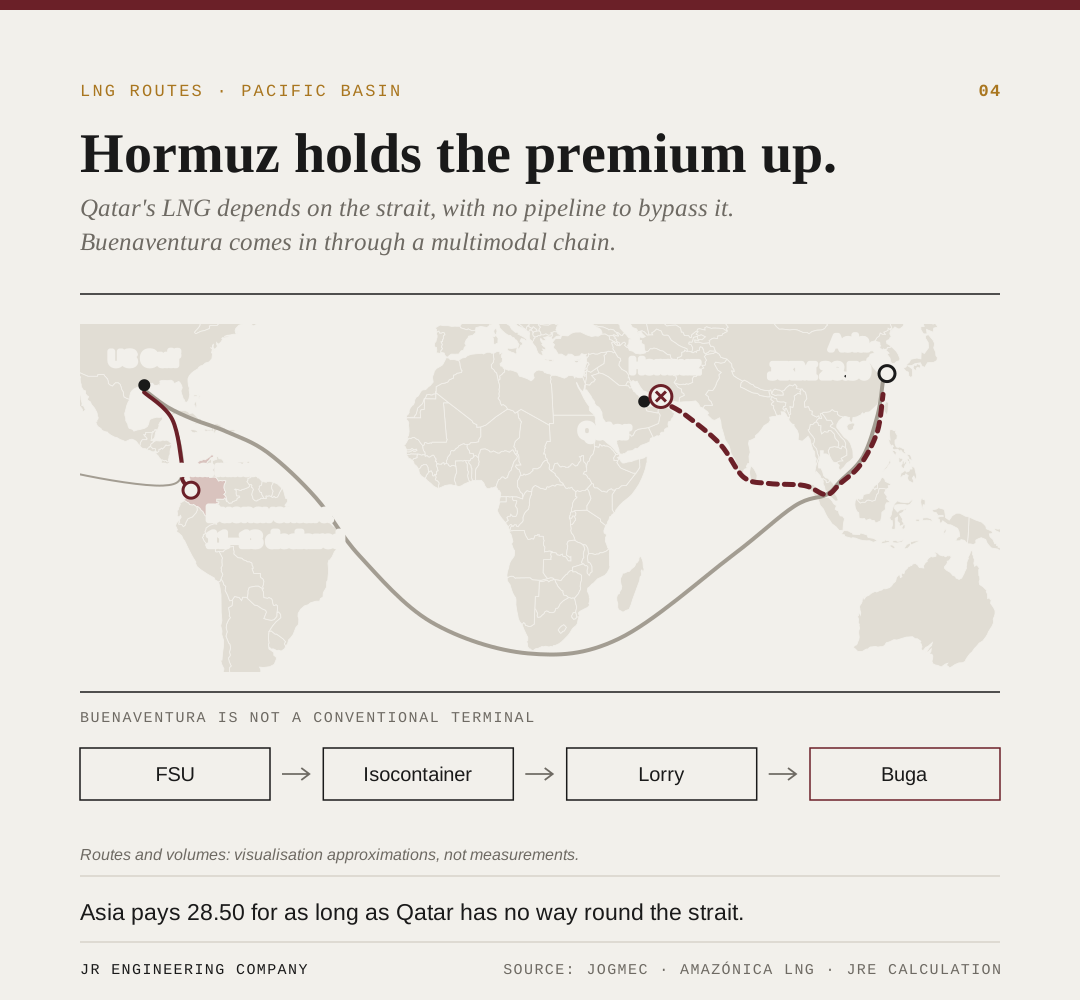
Trinidad built liquefaction without enough molecule. Colombia is building regasification without a contracted one. The same sequencing error at opposite ends of the same chain.
And if exportable Venezuelan gas appeared tomorrow, the seller's sums would not change just because the gas is next door. A producer with access to the Atlantic compares Cartagena with Rotterdam. Distance favours Colombia by about half a dollar; price counts against it by sixteen to eighteen.
Demand has already contracted, and the window is closing
The price is already showing up in demand. Between January and August 2026 non-thermal demand — everything except gas-fired power — fell by 58 billion Btu per day, 7% down on the same period of 2025, and industrial demand fell 23% (Promigas, 2026). Promigas names the mechanism: supply that is insufficient, costly or uncertain leads consumers and industry to cut activity or to replace gas with fuels that carry higher emissions and costs.
A terminal is sized against projected demand, yet almost a quarter of industrial demand has disappeared in eight months.
Even with Buenaventura, Coveñas and Puerto Bahía coming on stream, the deficit still widens about 2% by March 2027 (BMC, 2026).
The window is closing from the other end as well. Gas from the offshore Sirius discovery is expected to start flowing around 2031 and, because it is domestic, the market will rank it ahead of imports (BMC, 2026). Terminals financed over seven years or more are squeezed from both ends.
The sector has already said who pays
On 15 September 2026 Promigas presented its XXVII Report on the Natural Gas Sector in Colombia, setting out five priority decisions. Two of them say who pays.
Juan Manuel Rojas, president of Promigas, frames the decisions on two horizons, to be pursued together: securing imports and infrastructure in the short term, recovering domestic production and reliability in the medium and long term (Promigas, 2026).
The first decision proposes securing and diversifying imports through new infrastructure, wider contracting alternatives and clear rules for recognising the costs of supply, regasification and storage. The fifth proposes protecting consumers by guaranteeing timely disbursement and better targeting of subsidies to vulnerable households (Promigas, 2026).
Recognising those costs means passing them through to the tariff. Targeting subsidies means admitting that, once they are passed through, some households cannot pay them. The sector is not debating whether imported gas will be expensive. It is asking for the mechanism to charge for it and the cushion for those who cannot afford it.
Who puts up the capital
| Project | Capital announced | Source of funding |
|---|---|---|
| Regasificadora del Pacífico (Buenaventura–Buga) | US$172 M | Senior debt of US$130 M: Financiera de Desarrollo Nacional and BTG Pactual, US$65 M each |
| Puerto Bahía (Cartagena) | ~US$80 M | Frontera Energy (TSX: FEC), plus a seven-year lease of a floating storage and regasification unit (FSRU) backed by an Ecopetrol take-or-pay |
| Amazónica LNG (Palermo, Magdalena) | ~US$150 M | Private capital, EPC contract with Jereh Group |
A state development bank, an investment bank, foreign private capital, and a state-controlled company listed in New York that has taken on seven-year take-or-pay obligations (Frontera Energy, 2026). If the gas arrives at a price the end user cannot pay, the difference is split between the tariff and the balance sheet. Short of a renegotiation that nobody has announced, there is no third option.
And the order in which things were signed matters. The leases and the take-or-pay are signed; the supply is not. As at 16 September 2026, no public source records an award in the supply process Ecopetrol opened on 30 July, whose timetable set notification of the result for 4 September (Ecopetrol, 2026a). A review of its press room, of its material-information disclosures to the market and of its Form 6-K filings with the SEC between 31 August and 15 September turns up no communication whatever on gas supply (Ecopetrol, 2026b).
All saddled up, and no horse.
Counter-position acknowledged
The incumbent is expanding capacity, so the business works. Promigas brought forward to October 2026 the SPEC LNG expansion planned for September 2027, a further 58 million cubic feet per day, to 533, under a licence amended by the environmental authority, ANLA, through Resolution 002149 of 11 August 2026 (Promigas, 2026; ANLA, 2026). The objection has force: nobody brings capacity forward by eleven months if they think it useless. But Promigas is paid for moving gas — transport, distribution and regasification, on regulated assets and volumes (Promigas, 2025) — not for the margin on the molecule. Bringing capacity forward ahead of El Niño is rational for that business. Committing capital for seven years against the margin on the cargo is a different exposure, and others are carrying it.
The spread is temporary and will normalise. To call the divergence temporary you have to say since when, and the answer is not March 2026. The energy crisis began in 2021, before Russia's invasion of Ukraine. In 2020 TTF and Henry Hub moved almost in step, with a volatility ratio of 1.18; between 2021 and 2023 that ratio ran from 1.8 to 2.8, with no cointegration between the two in 2020–2022 (Wikipedia, 2026; Gases, 2026). On top of that divergence came the war and, in 2026, Hormuz. Each shock is temporary. What survives all of them is not.
The seller's conduct is suggestive, not conclusive: Venture Global sold its commissioning output on the spot market from 2021 to 2023 while its long-term buyers waited (Enyo Law, 2026), and in 2026 its Plaquemines plant is doing the same, with a promise to begin long-term deliveries on 31 October (Baird Maritime, 2026). What the forward curve does over seven years remains an open question. Anyone financing on normalisation should declare that assumption and its date.
Good commercial management will secure firm contracts. Conceded without reservation. If Colombia secures firm supply at a reasonable price, and the seller honours it — the Venture Global case shows that is not automatic — it will cover the deficit of the next few years. But the capital, the take-or-pay commitments and the seven-year leases have already been committed. A signed contract improves the position; it does not turn somebody else's molecule into your own.
Passing costs through to the tariff is legitimate, and the mechanism already exists. The problem is not its legitimacy but its size: it is not quantified in any public document, and industrial demand that has already fallen 23% suggests that pass-through has a limit the market is beginning to reveal.
Ecopetrol is already tendering on Henry Hub, so the price is not set by opportunity cost. This is the most concrete objection. Ecopetrol's bid document for supply delivered at Buenaventura requires a formula indexed to Henry Hub for the five years of the contract (Ecopetrol, 2026c). If that tender is awarded at a delivered price close to the cost basis, this thesis is weakened at its centre, and that should be said plainly.
But asking is not getting. The result is not public, and an indexed formula can load into the fixed premium what the indexation appears to give away: with Henry Hub at US$2.8, the figure that decides is the constant, not the index. What counts is the price awarded, not the template in the bid document.
The decisions at stake
For whoever has put up the capital, or is about to, the question is not whether the gas arrives. It is what happens to the project when it arrives dear, late or short:
- At what city-gate gas price does the project cover its debt service?
- On what minimum volume, if industrial demand has already switched away?
- What happens to the return if domestic gas comes on stream from 2031 with dispatch priority and the operating window shrinks to half the financed term?
- Who absorbs the take-or-pay if it is triggered before any molecule is under contract, for how long, and against which line of the balance sheet?
- How much of the capacity of the fourteen projects will really be built, and does your own plan still stand if the others start up too?
- How much of the overrun can go to the tariff and how much ends up on the balance sheet, and who confirms where that line falls?
- Who answers when the capacity exists, is being paid for, and the gas does not arrive?
Confidence & limits
This is a position essay. The figures on the Colombian market, production, reserves, demand, capital and issuer disclosure come from primary sources. International prices from July to September 2026 carry lower confidence than the March and April points validated in the original series. The argument on timing rests on a published econometric study (Gases, 2026) and a reference entry; it is presented as supporting evidence, not proof. Cargo arithmetic and price build-ups are reproducible from the declared assumptions; they are not quotations or offers. Seller behaviour is presented as a commercial pattern, not proof of breach. The Ecopetrol award remains open at the date of publication; absence of an announcement does not prove that no award has been made.
Conclusion
The whole public debate turns on one question: how to get gas. Few are asking the next one: whether gas, at the price the world sells it for, is still the right fuel for Colombia's energy mix.
There are two paths.
The first is the one the sector is already proposing: recognise the cost in the tariff and target subsidies. It is coherent and it can be done. It also means the nation absorbs the cost — through the bill or through the exchequer — for as long as the dependence lasts, a sum no public document has yet put a number on.
The second is less comfortable: to ask whether an energy mix that imports a third of its gas in the peak month, with reserves that have almost halved and industrial demand that has already contracted 23%, should go on allocating capital to receiving a fuel whose price it does not control.
That question is not ideological. It is economic.
There is no good fuel and no bad fuel. There is the fuel that is available. And available means two things at once: that it physically exists and that it can be paid for.
A fuel that arrives but that the user cannot buy is not available. It is present.
Nor is this position beyond challenge. Two specific facts would refute it: an award of Ecopetrol's Buenaventura tender at a delivered price close to the cost basis, or a JKM and TTF forward curve for 2027–2030 below US$12/MMBtu.
Until then, the burden of proof lies with whoever finances against the cost basis.
The exercise worth doing is not to audit somebody else's figure. It is for each funder to rebuild the economics of their own project, with their own data and their own assumptions on price, volume and window, and then put it to the only test that matters:
does it survive a retrospective by a hostile outsider?
If firm contracts appear tomorrow at a bearable price, the country will have got through the difficult years. That matters.
But the bet is still open the day after signing.
Because what was bought was the capacity to receive, not gas.
References
- Al Jazeera. (2026, 24 March). QatarEnergy declares force majeure on some LNG contracts due to Iran war.
- Autoridad Nacional de Licencias Ambientales. (2026). Resolución 002149 del 11 de agosto de 2026 — modificación de licencia ambiental de SPEC LNG.
- Baird Maritime. (2026, 9 March). Venture Global LNG promises on-time cargoes at agreed rates [Reuters].
- Bolsa Mercantil de Colombia. (2026). Foro del Gas 2026: contratación, precios de mercado primario y proyecciones de déficit. Via Valora Analitik, 30 July 2026.
- Ecopetrol S.A. (2026a). Ecopetrol abre nuevo proceso para contratación de suministro de gas bajo la modalidad Delivered Ex-Ship en Buenaventura. 30 July 2026.
- Ecopetrol S.A. (2026b). Form 6-K filings with the Securities and Exchange Commission, 31 August to 15 September 2026.
- Ecopetrol S.A. (2026c). Bid Document for LNG Tender on a Delivered Ex-Ship (DES) Basis. 16 March 2026.
- Enerdata. (2025, 13 October). Shell gets US green light to resume Trinidad-Venezuela gas deal.
- EnergyNow. (2026, 30 July). QatarEnergy buys 33 US LNG cargoes to offset Hormuz disruption [Reuters].
- Enyo Law. (2026). Divergent Outcomes in LNG Arbitrations: BP and Shell face off with Venture Global.
- Frontera Energy Corporation. (2026). Frontera Becomes Pure-Play Infrastructure Company. 1 June 2026.
- GaffneyCline. (2025, June). Market Advice and Estimates of Contemporary LNG Contract Prices, Report #7 [Report for the Australian Competition and Consumer Commission].
- Gases. (2026). Fragmentation and Vulnerability in the Global Natural Gas Market for a Sample of 59 Countries: A Combined Approach of Econometric Modeling and Hierarchical Clustering, 6(3), 30. MDPI. https://doi.org/10.3390/gases6030030
- Global LNG Hub. (2026). Weekly JKM, TTF and Henry Hub reports, July–September 2026.
- Insurance Journal. (2026, 3 March). Judge Rejects Shell's Bid to Overturn Arbitration Award With Venture Global.
- JOGMEC. (2026, 14 September). Weekly Trend of Natural Gas and LNG Prices [JOGMEC Journal].
- JR Engineering Company. (2026a). Five months later: the molecule recovered, the premium didn't. 3 August 2026.
- JR Engineering Company. (2026b). The chokepoint premium — where an energy shock's rent actually lands. 1 July 2026.
- La República. (2026). De 14 proyectos de regasificación a nivel nacional, solo uno está en operación.
- Natural Gas Intelligence. (2026). Trinidad and Tobago Taking Steps to Secure Feed Gas for Atlantic LNG.
- OilPrice. (2026, 30 July). Qatar turns to American LNG after Iran war cripples Ras Laffan.
- Portafolio. (2026). Statements by Alberto Consuegra, president of Amazónica LNG, on the sale price range.
- Promigas. (2025). Informe Integrado de Gestión 2025.
- Promigas. (2026). XXVII Informe del Sector Gas Natural en Colombia, InfoGas 2026. Statements by Juan Manuel Rojas. Reported by Narciso De la Hoz G. in Forbes Colombia, 15 September 2026.
- QatarEnergy. (2026, 4 March). Declaration of force majeure on Ras Laffan production and the closure of the Strait of Hormuz.
- The New Arab. (2026). QatarEnergy's 33-cargo US spot purchase to offset Hormuz disruption.
- Wikipedia. (2026). Global energy crisis (2021–2023) [Reference entry]. Post-pandemic origin of the global energy crisis, predating Russia's invasion of Ukraine.