A mandate without a meter
Competitiveness has moved to the top of the agenda and lost its meaning on the way up. MGI notes that the World Bank's framework identifies some 1,200 contributing factors. A word that requires 1,200 factors is not a metric; it is a mood.
The McKinsey Global Institute's June 2026 report makes one clean move to escape this. It uses productive investment as the proxy — firms invest where they expect to succeed, so where capital goes is the revealed verdict. That is the headline. The part worth keeping is underneath it.
What MGI actually built
MGI takes ten real investments — from nuclear and steel to semiconductors and biopharma R&D — and rebuilds each as a levelized cost: every operating cost, debt repayment, interest and an acceptable return over the asset's life, expressed as the unit price at which the project breaks even. Then it reads the gaps one driver at a time.
Advanced-economy costs run 50 to 300% above the best-in-class location, and the composition differs by case: in manufacturing the gap is mostly wages unmatched by productivity; in R&D it is mostly speed. Nuclear runs $65/MWh in South Korea against $190 in France, with capital expenditure — construction, financing and equipment — carrying about three-quarters of that gap rather than fuel or physics; construction alone is about half of it. Semiconductors show the narrowest gap, $2,800 a wafer in Taiwan against $4,000 in Germany; automotive R&D the widest, $445 a vehicle against $1,600.
The point is not the numbers. It is that the construction is explicit enough to carry conditions of use.
Six guardrails the construction itself establishes
None is imposed from outside. Each follows from a choice MGI made and documented.
One — the band is comparative, not a target. It tells you what has been demonstrated elsewhere, not what your project must cost. Used as a target, a benchmark becomes a budget imposed by someone else's geography. What it supplies is the outside view: pricing a project against the recorded outcomes of a reference class rather than the team's own narrative of this one.8 With a limit its own authors state — an outside view built on precedent may fail on outcomes outside all precedent. That limit is why guardrail six exists.
Two — the comparison is deliberately clean. Every exhibit is stated before taxes and direct subsidies, and MGI says plainly that both are excluded and that both matter. That is not a gap; it is what gives the band its authority, because it answers what does producing here actually cost rather than what makes producing here look cheap this year. It also sets the trap: comparing your own subsidised number against a pre-subsidy band is a category error, not a pass. Europe currently subsidises energy for heavy industry, sometimes by more than half of total cost, and implicit subsidies differ by as much as eight times between regions. A project inside the band on that basis is not inside the band.
Three — inside the band proves nothing. The spread between locations runs from 1.4x to 3.6x. Landing inside it means you resemble economics already demonstrated; it does not mean your build is sound. Compensating errors sit inside a wide band comfortably — and so does anchoring: a team that has seen the band adjusts toward it, one of the most robustly documented failures of numerical judgment under an available reference value.7 The band meant to test the estimate ends up shaping it.
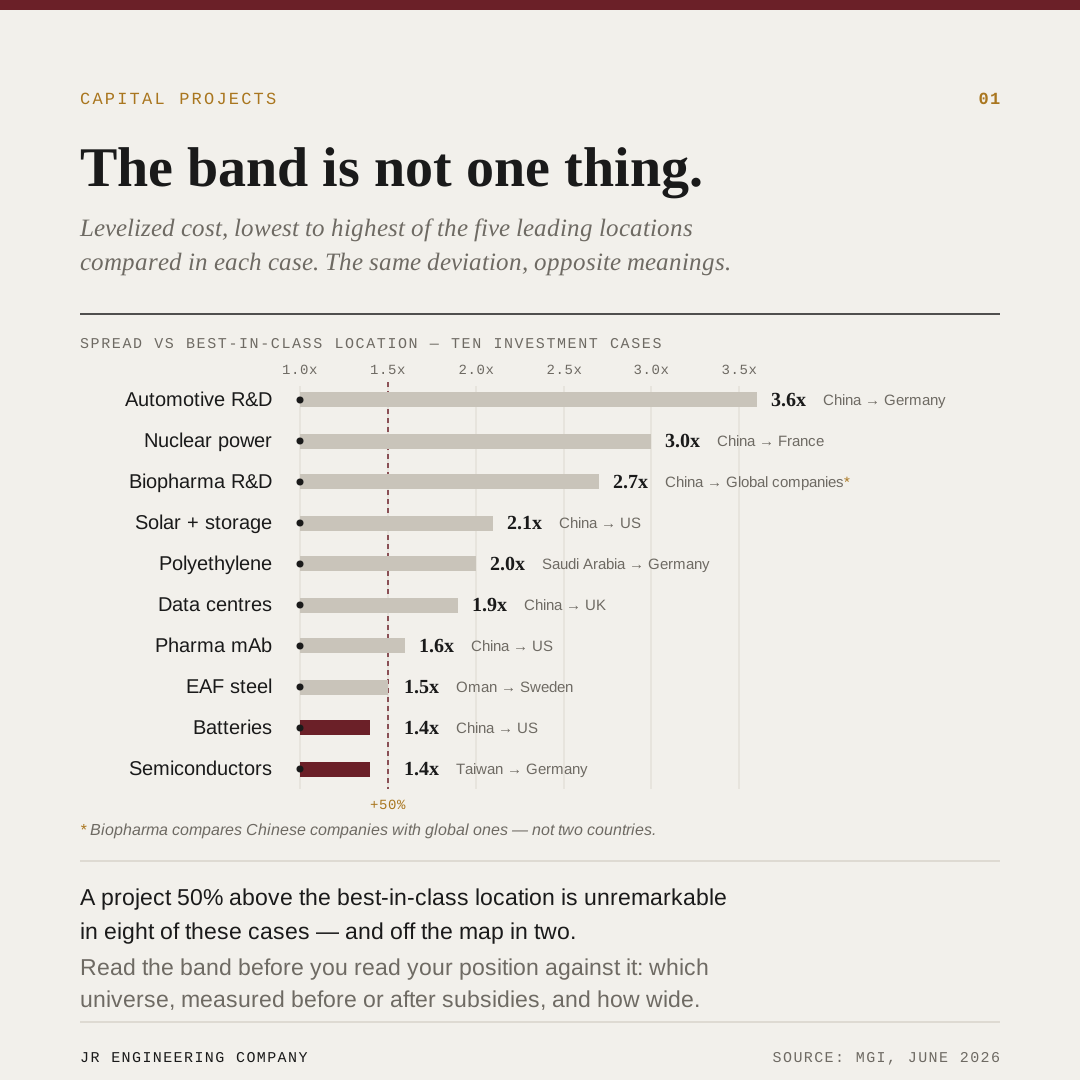
Four — outside the band is a claim, and claims decompose. MGI never stops at China $52, US $110: it splits the difference into labor, productivity, construction, energy, materials, financing and time to market. That is the standard a deviation has to meet. Our project costs 30% more is not information. That 30% is construction schedule and interface-driven rework is — rework created by interfaces left undefined between contractors and settled on site.
Five — a selected frontier is not a market distribution. MGI examines the top five locations per case and calls the ten illustrative rather than representative. The band maps what was selected. I am inside the MGI range, therefore I am at market does not follow.
Six — the advantage has to outlive its cause. This is an extension of MGI's logic, not a finding of it. Capital is committed for twenty to forty years; subsidies are granted on political cycles. A position that depends on a distortion is exposed to the horizon of the distortion, not of the asset. That does not require believing markets always win — only that the subsidy is not guaranteed for thirty years, which is verifiable case by case.
The reverse case keeps the guardrail honest. A position can sit outside the band because the band is about to move: energy-economy models spent two decades overestimating what solar and batteries would cost, an error documented by backtesting against more than fifty technologies.9 A project claiming to be cheaper than every demonstrated case is usually wrong and occasionally early.
Why the asymmetry is legitimate
The asymmetry is deliberate. Inside means you resemble what has been demonstrated — weak evidence, easily produced by luck or offsetting mistakes. Outside means your economics differ from everything in the set — a strong signal, and signals demand explanation. The benchmark does not sanction. It sorts your number into unremarkable or needs an account.
Taking the guardrails to a project
The sequence follows from the guardrails. First, establish what the band represents: which universe, what treatment of subsidies and taxes, at what scale. A band built on subsidised projects, or at a different scale, is not a guardrail — it is noise with decimals. Then locate the project on the same basis: pre-subsidy against pre-subsidy, or the comparison is void. Then, if there is a deviation, decompose it until it names a driver.
Once named, the driver faces two tests that belong to the decision rather than the measurement.
Is it given, or chosen? Wages are set by the whole economy. Build method, speed and interfaces carried undefined into execution are decided at the front end, and only there — and MGI's own decomposition sizes the difference: capex under 30% of the gap, labor about 35%, speed and scale roughly a tenth.
And does it survive its cause? A deviation explained by a subsidy is not explained — it is deferred until the subsidy is.
Confidence & limits
This piece reads one report. Every claim attributed to MGI here was checked against the primary document under adversarial review — the instruction was to refute, not to confirm — and the construction it describes is MGI's own, not a reinterpretation.
Three limits are worth stating plainly. The World Bank's 1,200 contributing factors are cited as MGI reports them; the underlying framework was not located, and the figure is not asserted directly. The sixth guardrail — that an advantage has to outlive its cause — is an extension of MGI's logic, not a finding of it, and it is argued rather than measured. And the claim that a position against the band admits only two explanations has not been tested against its own falsifier here: that would require project closures with sanction-stage estimates disclosed, which is archive work rather than reading.
What the piece does establish is narrower and firmer: the conditions of use are legible from the construction itself, and a benchmark read without them will be read as a verdict.
The instrument, in one line
MGI turned a slogan into a construction, and documented it well enough that its limits are legible. Take the limits seriously and the benchmark stops being a verdict.
One qualification, and it cuts at the instrument itself. A band only sorts while the comparison set still describes the world. On a learning curve the set is what is out of date, and being far outside it is not a claim to explain but a position the band has not caught up with. The guardrail is not exempt from the test it imposes: it too has to outlive its cause.
Competitiveness is a number, not a narrative. Inside the band proves nothing. Outside it is not a mistake — it is a claim, and claims have to name their driver and outlive their cause.
References
- McKinsey Global Institute. Catalyzing competitiveness: Where investment happens and why. June 30, 2026.
- MGI, levelized-cost decomposition across ten investment cases (nuclear, solar, EAF steel, polyethylene, pharma manufacturing, batteries, data centers, semiconductors, automotive and biopharma R&D), same report.
- MGI driver attribution of the cost difference (capex < 30%, labor ~35%, performance drivers ~10%), same report.
- MGI method: exhibits stated before taxes and direct subsidies, with both excluded and declared material; universe defined as the top five investment locations per case, cases selected as illustrative, same report.
- World Bank competitiveness framework (~1,200 contributing factors) — as reported by MGI; the underlying World Bank source has not been verified independently and the figure is attributed to MGI's citation, not asserted directly.
- Companion Methodology Note: Capital Intensity Is a Symptom: Execution Structure and the Typology Owners Don't Buy (EC-MN), JR Engineering Company, 2026.
- Tversky, A. & Kahneman, D. Judgment under Uncertainty: Heuristics and Biases. Science, 185(4157), 1124–1131, 1974. — anchoring-and-adjustment: exposure to an available reference value biases subsequent numerical judgment toward it.
- Flyvbjerg, B. From Nobel Prize to Project Management: Getting Risks Right. Project Management Journal, 37(3), 5–15, 2006. — reference-class forecasting; the outside view corrects the inside view by pricing against recorded outcomes rather than the project's own narrative.
- Way, R., Ives, M. C., Mealy, P. & Farmer, J. D. Empirically grounded technology forecasts and the energy transition. Joule, 6(9), 2022. — energy-economy models systematically overestimated renewable costs and underestimated deployment; method statistically validated by backtesting on more than fifty technologies.